Foothill Garden
Howard McMinn Manzanita
Arctostaphylos x 'Howard McMinn'

This Manzanita shrub has been widely used in developing manzanita cultivars and hybrids for garden use. Its fruit resembles a tiny apple.
- Plant Type: Evergreen shrub
- Water Needs: Low
- Mature Height: 4' - 8'
- Mature Width: 4' - 8'
- Sun Needed: Full Sun to Partial Shade
- USDA Zones: 5 to 11
- Colors: Red-brown, Green
- Bloom Color: White
- Bloom Season: Spring
- Native To: California, Oregon
Pacific Mist Manzanita
Arctostaphylos x 'Pacific Mist'

Pacific Mist Manzanita is fast growing with twisting, pinkish to purplish branches. These branches have foliage that is greyer in hotter inland areas and greener near the coast. It produces small white flowers and red berries.
- Plant Type: Evergreen shrub
- Water Needs: Low
- Mature Height: 2' to 3'
- Mature Width: 6' to 12'
- Sun Needed: Full Sun to Partial Shade
- USDA Zones: 8 to 10
- Colors: Pinkish to dark Purple-brown branches, Grey-green leaves, and Red berries
- Bloom Color: White
- Bloom Season: Winter
- Native To: California
European Grey Sedge
Carex divulsa

European Grey Sedge has dark green, grass-like foliage. Roots form dense, broad arching clumps. Spikes of small flower heads emerge green and turn brown. It is a great clumping plant for use in solid stands or combined with other sedges, grasses and herbaceous plants for a natural meadow look.
- Plant Type: Perennial
- Water Needs: Moderate
- Mature Height: 12" - 18"
- Mature Width: 1' - 2'
- Sun Needed: Full Sun to Partial Shade
- USDA Zones: 4 to 10
- Colors: Green
- Bloom Color: Brown
- Bloom Season: Spring
- Native To: Europe and Northern Africa
Snowball Monterey Ceanothus
Ceanothus rigidus 'Snowball'

Ceanothus 'Snowball' is a dense mounding shrub that is covered in pure white balls of flower clusters in the spring. The flowers really stand out against the plant's arching branches of dark green leathery leaves. It is best near the coast but can take inland heat.
- Plant Type: Evergreen shrub
- Water Needs: Low
- Mature Height: 4' - 6'
- Mature Width: 6' - 10'
- Sun Needed: Full Sun
- USDA Zones: 8 to 10
- Colors: Medium Green
- Bloom Color: White
- Bloom Season: Spring to Winter
- Native To: California
Deodar Cedar
Cedrus deodara
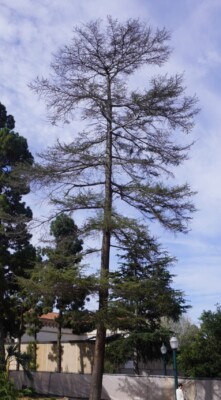
The Deodar Cedar is a large evergreen conifer commonly used as a specimen tree for expansive lawns or pruned into screens and hedges. It is the most pendulous of the true cedars, characterized by drooping branchlets and gracefully nodding branch tips.
- Plant Type: Evergreen tree
- Water Needs: Medium
- Mature Height: 40' to 50'
- Mature Width: 39' to 40'
- Sun Needed: Full Sun
- USDA Zones: 7 to 8
- Colors: Green needles
- Bloom Color: Non-flowering
- Bloom Season: Non-flowering
- Native To: Himalayas
Mountain Mahogany
Cercocarpus betuloides
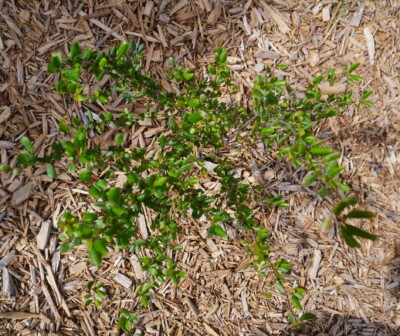
Mountain Mahogany is known for its long, fuzzy seeds that resemble curled feathers and shine in the sun. "Cercocarpus" means fruit with a tail. The evergreen birch-like leaves have edges that are smooth at the bottom and toothed at the top. Its small yellow flowers attract hummingbirds and butterflies. Mountain Mahogany is named for its dark bark color, but this plant is actually a member of the Rose family.
- Plant Type: Evergreen shrub
- Water Needs: Very low
- Mature Height: 8' - 20'
- Mature Width: 10' - 12'
- Sun Needed: Full Sun to Partial Shade
- USDA Zones: 7 to 9
- Colors: Dark Green to Yellow-green
- Bloom Color: Creamy-white
- Bloom Season: Winter, Spring
- Native To: Western United States, Baja California
Santa Cruz Island Buckwheat
Eriogonum arborescens

A fast growing compact mounding evergreen shrub, the Santa Cruz Island Buckwheat is usually a bit wider than tall. It develops a trunk and stems that have red ribbony bark and bears narrow hairy green leaves at the ends of the branches.
- Plant Type: Shrub
- Water Needs: Low
- Mature Height: 3' - 4'
- Mature Width: 4' - 6'
- Sun Needed: Full Sun
- USDA Zones: 7 to 10
- Colors: Blue-green leaves
- Bloom Color: Pink
- Bloom Season: Summer
- Native To: California
Moreton Bay Fig
Ficus macrophylla
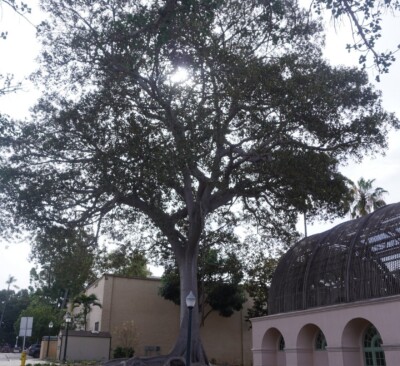
Like the magnificent specimens in Balboa Park, Moreton Bay figs are far too large for home gardens or street plantings, but they make extraordinary park trees. Mature individuals develop massive buttressing roots that radiate from the trunk, and in more humid climates they may also produce dramatic aerial roots.
- Plant Type: Evergreen
- Water Needs: Medium
- Mature Height: 60'
- Mature Width: 70' - 75'
- Sun Needed: Full Sun
- USDA Zones: 1 to 9
- Colors: Glossy dark green leaves above, Brown below
- Bloom Color: Inconspicuous flowers, purple or yellow edible fruit
- Bloom Season: Summer
- Native To: Eastern Australia
Creeping Fig
Ficus pumila
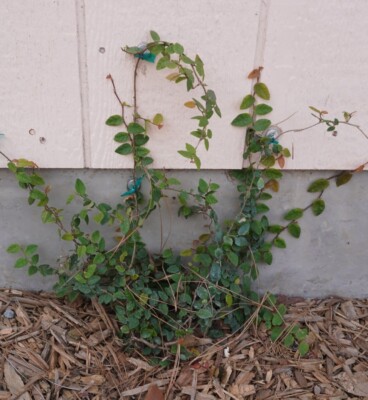
Creeping fig is a broadleaf, evergreen woody climber in the mulberry family. It climbs like English ivy by attaching itself to walls or supports via clusters of short roots. When grown outdoors, pear-shaped to cylindrical figs, mostly solitary, may appear throughout the year. They are green with white flecks maturing to purple, densely hairy,
- Plant Type: Vine
- Water Needs: Medium
- Mature Height: 10' - 15'
- Mature Width: 3' - 6'
- Sun Needed: Partial Shade
- USDA Zones: 9 to 11
- Colors: Green
- Bloom Color: Insignificant
- Native To: Eastern Asia
Island Alum Root
Heuchera maxima

Island Alum Root is a versatile flowering plant for many landscaping applications. Its large multi‑lobed foliage forms compact mounds that work beautifully as a groundcover, and it also serves as a pollinator‑friendly alternative to common exotic shade plants such as Hostas.
- Plant Type: Evergreen perennial
- Water Needs: Low
- Mature Height: 2' - 3'
- Mature Width: 2' - 3'
- Sun Needed: Partial Shade
- USDA Zones: 4 to 9
- Colors: Green
- Bloom Color: Pinkish-white
- Bloom Season: Spring
- Native To: California Channel Islands
Dwarf Karo Pittosporum
Pittosporum crassifolium 'Compactum'

Dwarf Karo Pittosporum is adorned with olive green rounded leaves with greyish hairs on their undersides. New leaves exude a brighter yellow-green hue. Lightly fragrant maroon blossoms appear during spring. Its an excellent fit for borders or hedges.
- Plant Type: Evergreen shrub
- Water Needs: Low
- Mature Height: 2' - 3'
- Mature Width: 4' - 6'
- Sun Needed: Full Sun to Partial Shade
- USDA Zones: 9 to 11
- Colors: Olive-green with Grey hairs
- Bloom Color: Maroon
- Bloom Season: Spring
- Native To: New Zealand
Western Sword Fern
Polystichum munitum

The Western Sword Fern has large arching, dark green erect fronds in clumps of 75 to 100 fronds that are born from a crown of scaly rhizomes. Sori (spore sacs) are yellowish and arranged in rows on the undersides of the fronds.
- Plant Type: Herbaceous perennial
- Water Needs: Low to moderate
- Mature Height: 3" - 4"
- Mature Width: 2" - 4"
- Sun Needed: Partial Shade
- USDA Zones: 5a to 9b
- Colors: Green
- Bloom Color: Non-flowering
- Bloom Season: Non-flowering
- Native To: Western North America
Eve Case Coffeeberry
Rhamnus californica 'Eve Case'

Eve Case Coffeeberry is a versatile shrub with a dense, rounded growth habit. It has leathery green leaves on reddish stems. Small flowers are followed by large berries that ripen to red-black by autumn. Attracts pollinators, birds, and other wildlife.
- Plant Type: Evergreen shrub
- Water Needs: Low
- Mature Height: 6' - 8'
- Mature Width: 6' - 8'
- Sun Needed: Full Sun to Partial Shade
- USDA Zones: 7 to 10
- Colors: Green, Red
- Bloom Color: Greenish-white
- Bloom Season: Spring
- Native To: California
Evergreen Currant
Ribes viburnifolium

The Evergreen Currant is considered to be a rare and endangered plant in the wild. It has thin dark red stems bearing aromatic leathery dark green leaves on stems arching up and out from the center of the plant. The small rose pink star-shaped flowers held in open clusters appear in late winter to mid-spring.
- Plant Type: Evergreen shrub
- Water Needs: Low
- Mature Height: 3' - 4'
- Sun Needed: Partial Shade
- USDA Zones: 8 to 11
- Colors: Green, Red
- Bloom Color: Rose, Pink
- Native To: Santa Catalina Island to Baja California
Hummingbird Sage
Salvia spathacea

Salvia spathacea is a low growing sage that can be grown as a ground cover. It has aromatic leaves and pink flowers that bloom from late winter through the summer. Salvia spathacea is native to the grassy slopes along the California coastal ranges in from Solano County to Orange County and possibly north San Diego County.
- Plant Type: Evergreen
- Water Needs: Low
- Mature Height: 1' - 2'
- Mature Width: 4' - 5'
- Sun Needed: Full Sun to Partial Shade
- USDA Zones: 7 to 10
- Colors: Green
- Bloom Color: Pink
- Bloom Season: Spring, Summer
- Native To: California
Creeping Snowberry
Symphoricarpos mollis

Creeping Snowberry spreads via rhizomes, forming 3 to 4 foot wide patches. It has rounded light green leaves on slightly red stems, and pink flowers that give way to white berries. The flowers attract hummingbirds and the fruit is eaten by birds.
- Plant Type: Deciduous Shrub
- Water Needs: Low
- Mature Height: 1'
- Mature Width: 3' - 4'
- Sun Needed: Full Sun to Partial Shade
- USDA Zones: 5
- Colors: Green, White
- Bloom Color: Pink
- Bloom Season: Spring
- Native To: California
Asiatic Jasmine
Trachelospermum asiaticum

Asiatic Jasmine is a vine-like woody plant that is a low maintenance groundcover that is great for mass plantings and turfgrass alternatives. It may be used in planters, hanging baskets, or as a ground cover on sloped areas. Take advantage of its sweet-smelling flowers by allowing it to twine up fence, trellis, or arbor.
- Plant Type: Vine, groundcover
- Water Needs: Low
- Mature Height: 1' - 2'
- Mature Width: 10' - 12'
- Sun Needed: Full Sun to Partial Shade
- USDA Zones: 7a to 11b
- Colors: Dark Green to Red-bronze
- Bloom Color: White, Gold, Cream
- Bloom Season: Late spring to early summer
- Native To: China, India, Japan, Korea
Giant Chain Fern
Woodwardia fimbriata

Giant Chain Fern is the largest fern in North America. It has arching dark-green fronds and can be either evergreen or summer deciduous, depending on its growing conditions. It prefers at least some shade and some moisture, but does not like continually wet soil. It can be cut back to the ground at the end of winter.
- Plant Type: Evergreen or Summer Deciduous Fern
- Water Needs: Moderate
- Mature Height: 4' - 6'
- Mature Width: 4' - 6'
- Sun Needed: Partial Shade
- USDA Zones: 9 to 10
- Colors: Green
- Bloom Color: N/A
- Bloom Season: N/A
- Native To: Western North America